Paintings
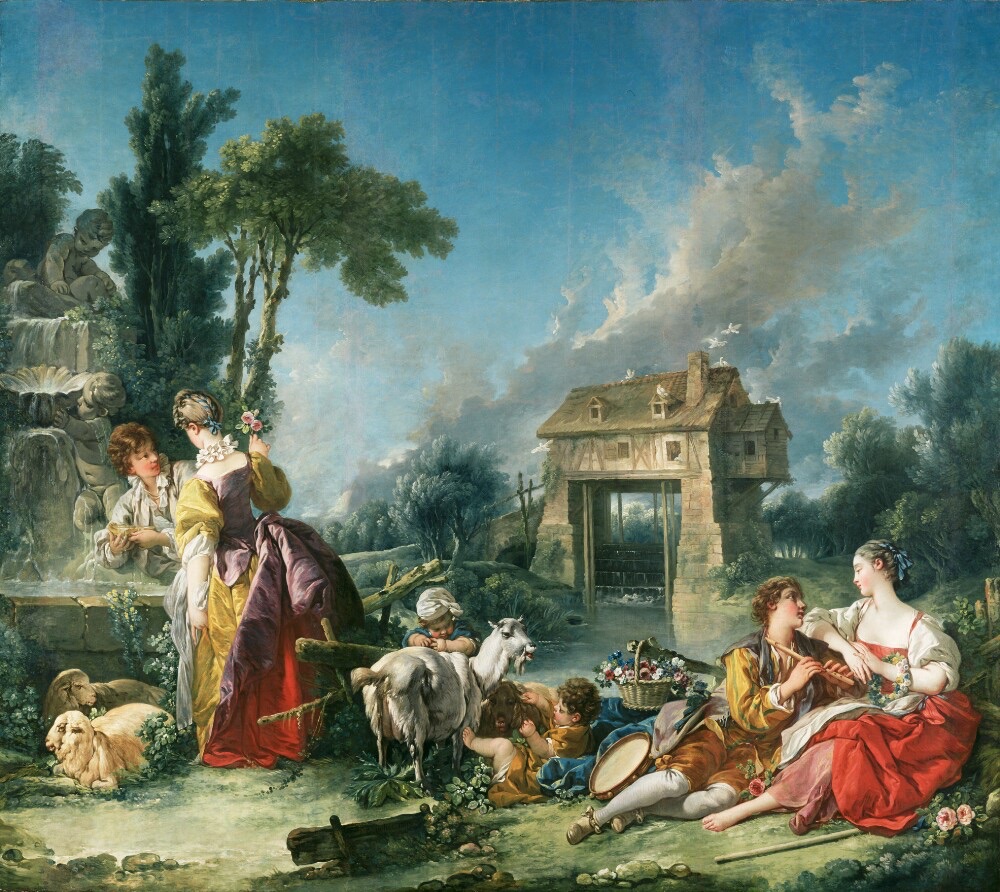
The Fountain of Love
A young man with a flute gazes languidly at his companion, a rosy-cheeked, barefoot woman dressed in red silk who returns his gaze longingly. Another youth offers a shell full of fresh water to a dainty maiden in a diaphanous gown of purple-gold and red satin. These amorous couples, accompanied by young children frolicking with goats, appear in an idyllic setting of lush, green, leafy trees under a pale blue sky with gray-pink clouds.By blending sensuality, covert eroticism, and refinement, pastoral paintings such as these brought the world of aristocratic society and amorous games to the countryside. The pastoral genre in which François Boucher excelled delighted his patrons, answering the contemporary nostalgia for nature and excluding coarse reality.The Fountain of Love, dated 1748, originally served as a finished cartoon for a tapestry, one of a series of six known as the Noble Pastorales; another one of this series and this painting’s pendant, *The Bird Catchers Coast*, is also in the J. Paul Getty Museum. Beginning in 1755, the Beauvais tapestry manufactory wove the tapestries directly over the cartoons. Eventually, the cartoons were cut up into sections and sold separately. Some of the tapestries survive, and their extended compositions reveal that the cartoons were originally even larger.