Sculpture & Decorative Arts
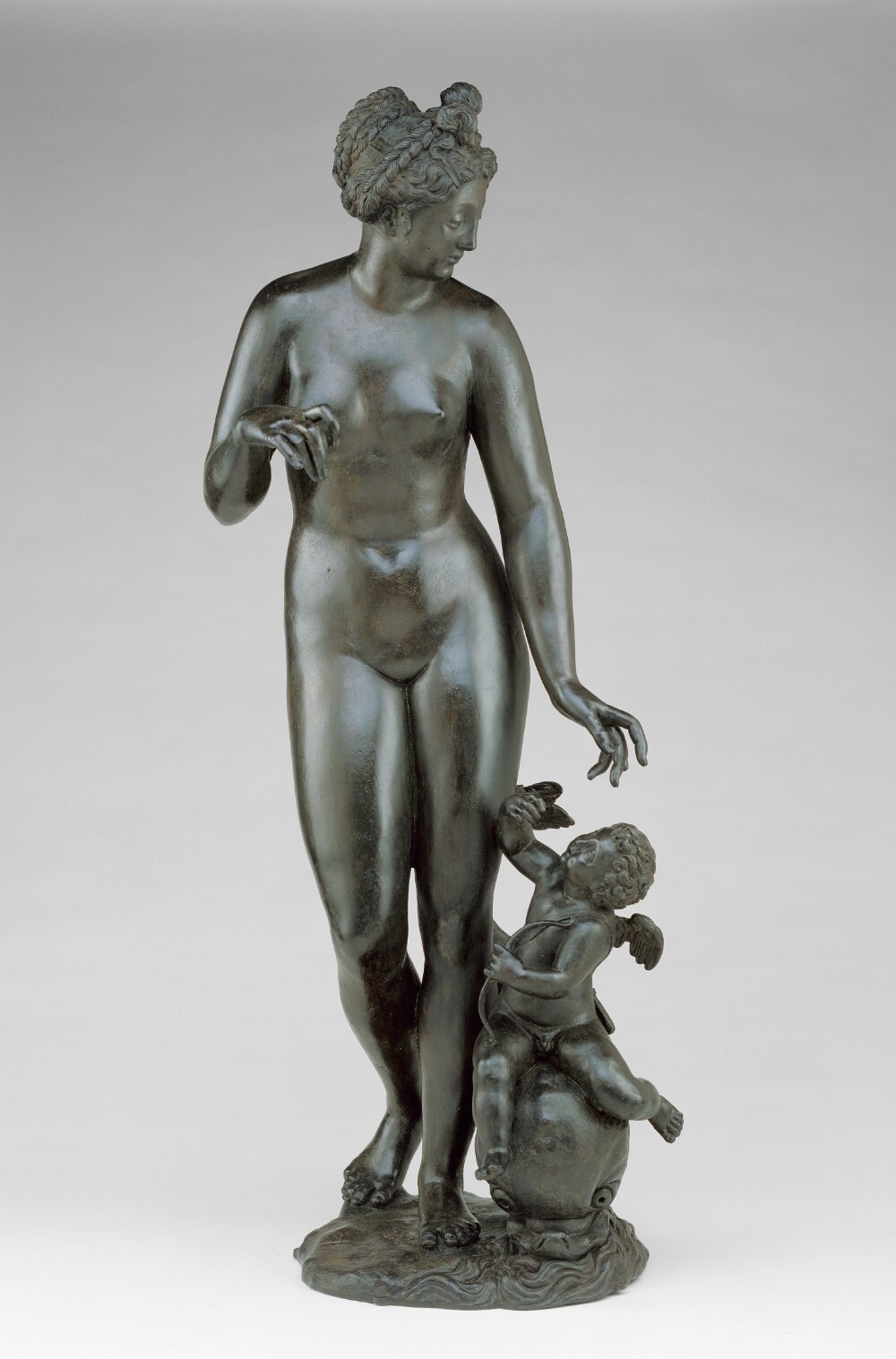
Venus and Cupid
On a circular base with swirls indicating waves, an elegantly coiffed, nude Venus looks down at Cupid while striding forward. Cupid sports wings and a bow and arrows in a sling over his back. Reaching up to his mother, he balances on a fantastic diving dolphin that has an almost human face. The figure of Venus is a study in contrasts: her elaborate hairstyle contrasts with her smooth flesh, and the detachment with which she takes away Cupid's arrow, now missing, disguises her passionate nature. Scenes like this one, drawn from Greek and Roman mythology, were popular in the 1600s and 1700s in France. By representing classical subjects, patrons and artists could justify depictions of the female nude and titillating images of amorous activity. Unusual holes left from the casting process in the top of Venus's head, in her right hand, and on the bottom of her feet may have been used to remove the core material. These holes may not have been visible from the work's original position and so were not disguised.