Antiquities
Grave Relief for Tation and Tatianos
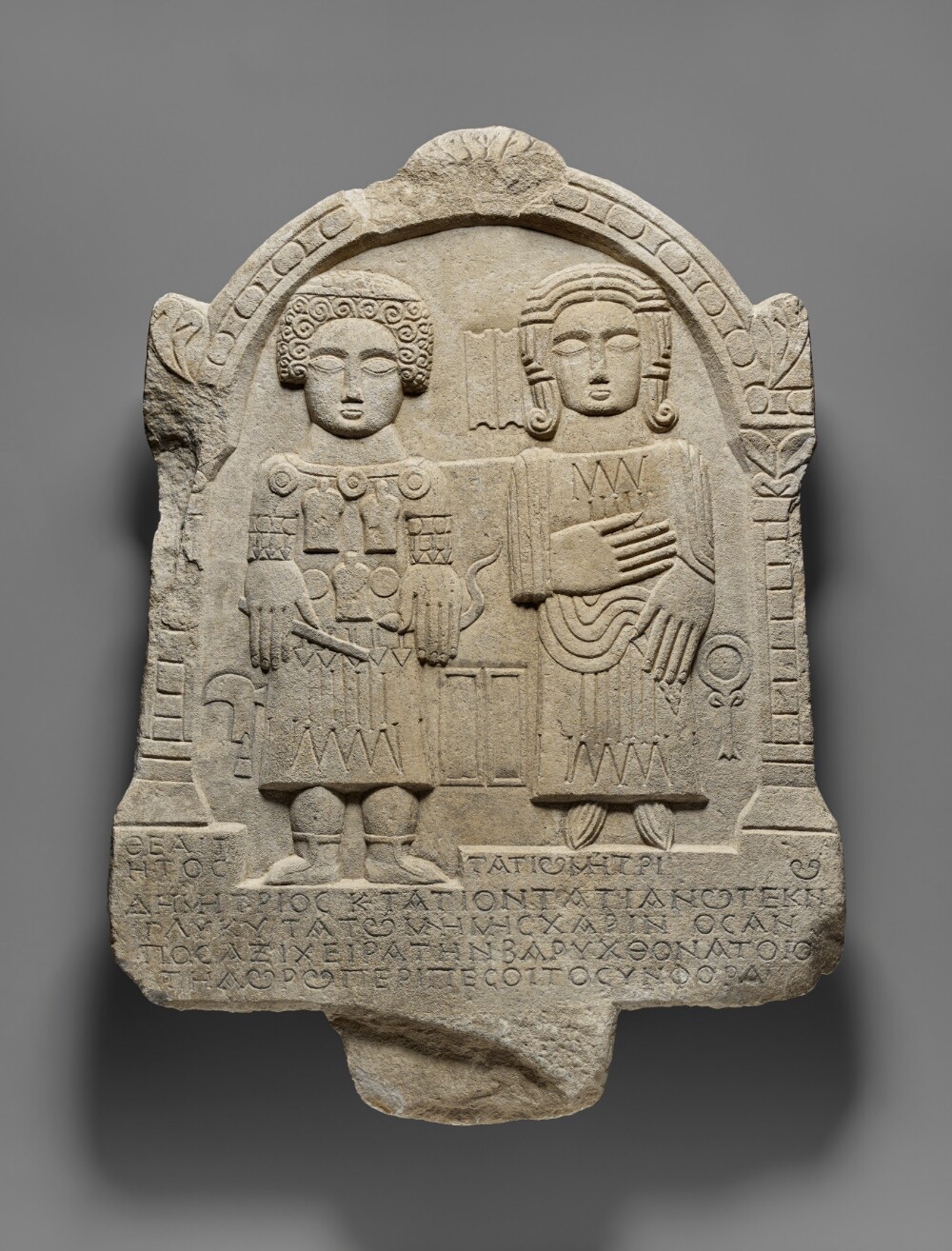
On this grave stele, a man and woman stand side by side within an architectural framework that takes the form of an arch with central and side ornaments (acroteria) supported by pilasters with leaf-decorated capitals. The man at left, wearing armor and boots, holds a whip by the handle. He has wide open eyes and curly hair. The woman’s hair hangs down on either side and curls upward at the ends. She wears a chiton decorated with zig-zags, a mantle draped across her thighs, and also boots. Objects beside them—a vine knife, writing tablets, a mirror, and a comb—serve as attributes for their idealized identities, the man as a soldier-farmer with pretensions to learning, and the woman as a beauty.The flat, frontal figures are characteristic of funerary reliefs from Phrygia (in present-day Turkey), and it is reasonable to interpret these figures as representing husband and wife. The Greek inscriptions at the bottom of the stele, however, reveal a more complex situation. The four lower lines read: “Demetrios and Tation for their sweetest child Tatianos in memory. May whoever lays a hand heavy with [envy] on this grave be struck by a similarly premature blow of fate.” Just above, near the feet of the two figures, almost as captions, another inscription reads “Theaitetos for his mother Tation.” It appears that Demetrios and Tation erected the stele in memory for one son, Tationos, who died prematurely, while another son, Theaitetos, added the second inscription after his mother had died. While the woman on the stele clearly represents Tation, the man could be taken to be her husband, Demetrios, or her deceased son Tationos. In either case, with all four members of the family mentioned, the relief ultimately commemorates them all.